Agentic OS - the tool to rule them all
 By: Ran Banker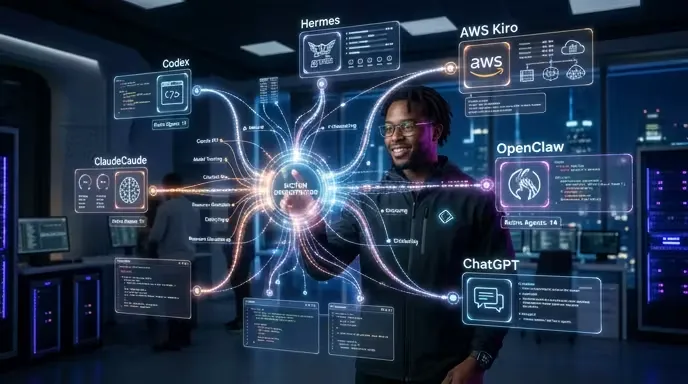
🧗 The Challenge
With the pace of the agentic landscape, we quickly find ourselves with several agentic tooling in our working environment. The tools run in silos, they each learn about us separately without sharing knowledge. We are missing a telemetric view to measure token usage, correlate between the different tools and understand how they are impacting our work. In some cases the underlying tooling, like Hermes or OpenClaw, offer a limited rudimentary UI.
💡 What's cool?
Use your agentic coding assistant to build your own customized Agentic OS. Wrap each agentic tool, share knowledge between the agentic entities, provide the missing telemetry, and offer a unified UI to best orchestrate and control the agentic entities.
⚠️ Disclaimer & Scope
In this post I will share several authors of their vision of a possible implementation of an Agentic OS. This is by no means an exhaustive list, but rather a collection of ideas and concepts that I found interesting.
🎯 The Solution
The shift from fragmented AI tools to an autonomous Agentic Operating System (Agentic OS) relies on three distinct pillars. Each serves a specific purpose in your architecture:
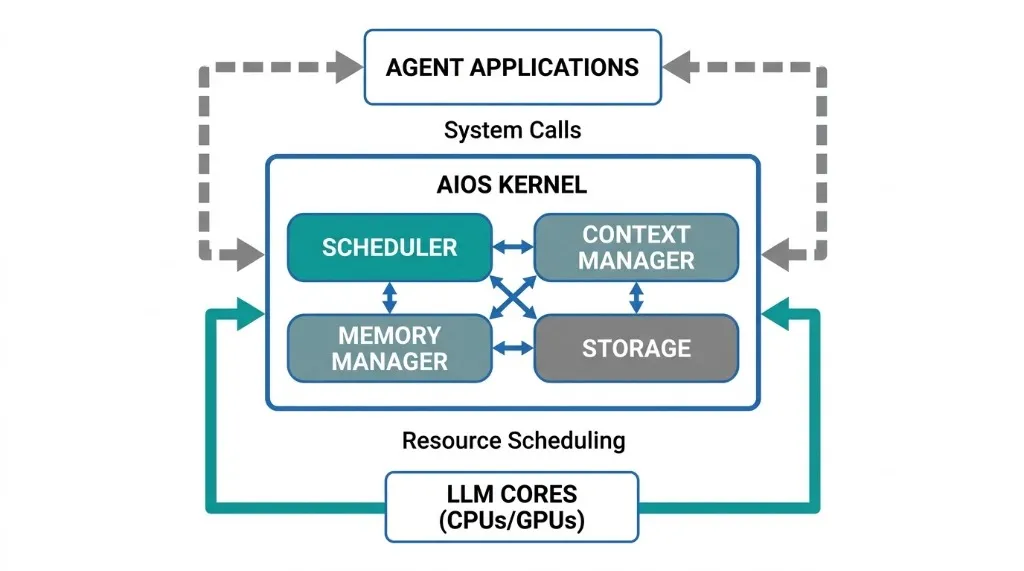
1. System-Level Kernels (The Engine)
- What makes it unique: It acts as the traffic controller for your LLM, handling task scheduling and preventing memory crashes (AIOS Kernel, AgentRM).
- Main Benefit / Use Case: Ensures stability when running dozens of concurrent agents. Perfect for heavy, automated backend processing.
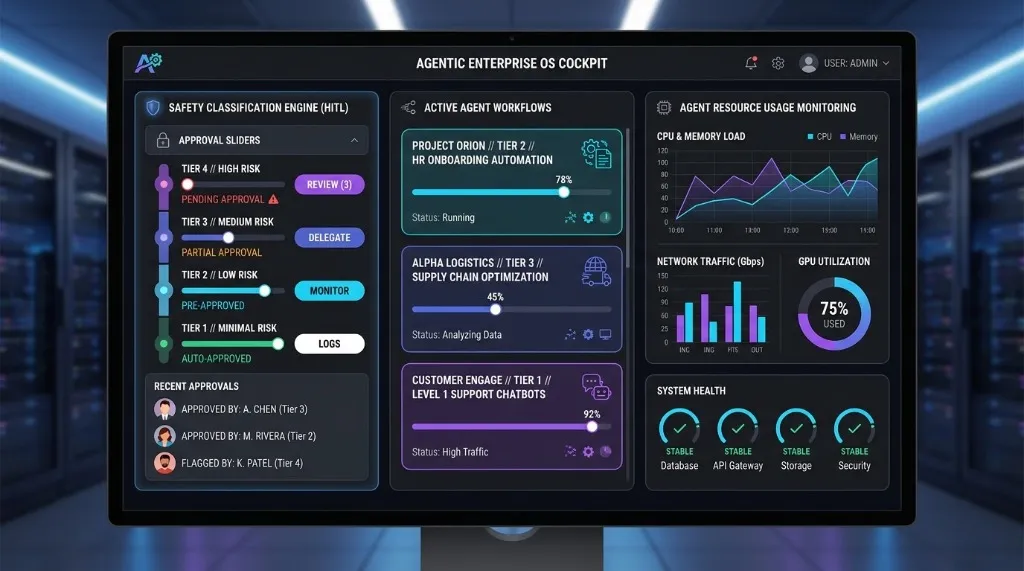
2. Unified Enterprise Cockpits (The Control Room)
- What makes it unique: Centralizes all multi-agent monitoring into a single UI, enforcing safety rules and permissions (Agentic Enterprise OS model).
- Main Benefit / Use Case: Gives human operators full visibility and control. Essential for compliance, HR, or finance workflows requiring human-in-the-loop oversight.
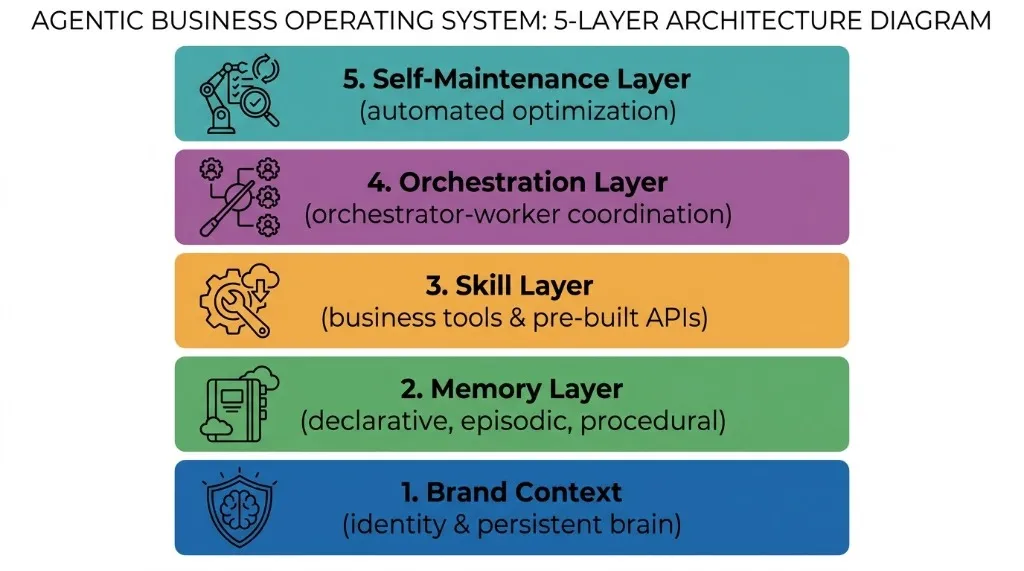
3. Standardized Skills & Memory (The Brain)
- What makes it unique: Packages workflows into reusable, modular skills equipped with persistent memory (GrowwStacks, MindStudio).
- Main Benefit / Use Case: Guarantees highly consistent, personalized outputs. Ideal for knowledge work like coding, copywriting, and customer support.
📊 Conclusion & Insights
Stop managing dozens of disconnected AI tools. By building an Agentic OS, you consolidate your AI workforce into a single, reliable system.
The core insight: A true Agentic OS gives you stable execution (Kernels), total visibility (Cockpits), and reliable outputs (Skills/Memory)—ultimately delivering zero context-loss and strict human oversight where it matters most.
⏭️ Suggested Next Steps
Start slowly: define one tool at a time, test, and iterate. It is a marathon, not a sprint. Evaluate your next steps based on your primary use case:
| Use Case | Core Pillar to Evaluate | Next Step to Implement |
|---|---|---|
| High-Volume Agents (e.g., automated research) |
System-Level Kernels | Deploy an AIOS Kernel sandbox to stress-test concurrent agents and memory persistence. |
| Security & Operations (e.g., HR/Finance) |
Enterprise Cockpits | Build an Agnos AgentOS pilot with a 4-tier risk classification for HITL safety. |
| Knowledge Work (e.g., Coding/Copywriting) |
Skills & Memory | Set up CLAUDE.md or MindStudio to A/B test 2-3 tailored skills against raw prompting. |
🙏 Acknowledgments
System-Level Kernels & Resources
Unified Enterprise Cockpits
Standardized Skills & Memory
General Architecture & Concepts
Get new posts straight to your Gmail.

💬 Join the Conversation
Have thoughts or questions on this article? Jump over to Medium to leave your comments and responses!