Re-imagine your org with AI
 By: Ran Banker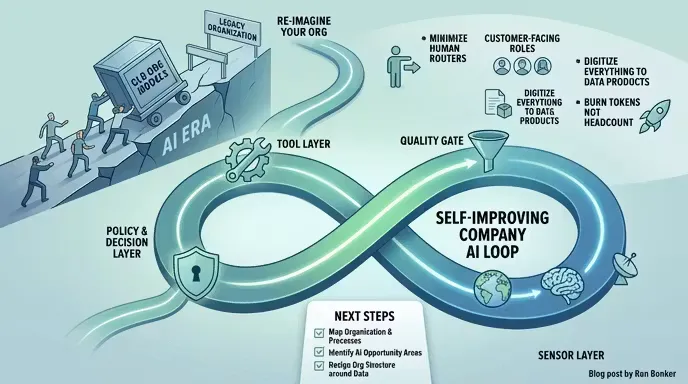
🧗 The Challenge
Coders work faster, non-coders can also optimize their workflows with AI, but the organization itself is still lagging behind. The old models of org structure and management are not suited for this new era of AI-native companies.
💡 What's cool?
The following YouTube video by Y Combinator is a great source of inspiration for this topic. They are discussing how the UI can revolutionize the way we work, which roles make the most impact and which roles or old way of work concepts are obsolete.
⚠️ Disclaimer & Scope
I am focusing on YCombinator ideas, with some I can relate, with some I am not sure I agree, but most important the ideas inspire thinking for changes yet to come.
🎯 The Solution
Tom Blomfield, from Y Combinator shares several concepts that can transform the way we think about company structure and management. They are describing the AI loop pillars:
1. Sensor Layer: Telemetry, support tickets, and external data
Build a layer that collects signals from all internal & external sources and makes them available to AI Agents.
2. Policy & Decision Layer: Rules on what requires human permission
Protect the assets and ensure the organization is compliant with internal and external regulations.
3. Tool Layer: Deterministic APIs (the AI’s code/skills)
AI based service providers like Casetext, in a YouTube video the co-founder and CEO Jake Heller, emphasize the importance of AI agents to have access to tools to act and execute tasks in a deterministic ways where the output is reliable and predictable. Constant testing and verification is crucial to maintain a high level of quality.
4. Quality Gate: Evals, safety filters, and high-risk reviews
The business context and skills become the core “company brain.”
Fascinating concepts on the new way to organize the company
- Remove the middle management that are considered as “human routers”
- Most important roles are the Agentic architects and the people that handle the edge cases, optimize the agentic framework with broad and deep understanding of complex systems, and focus on network edge positions with close customer facing relationships with the customers.
- Software is ephemeral: focus on the specs, on the business knowledge, as generating the software cost close now to nothing (I disagree at this point as code is not enough to bring a product to production). You will be able to re-generate the products with stronger future AI models.
- Burn tokens not headcount: It actually reversed my thinking, I was thinking that token busting is a hype without building the right ROI for business needs, YCombinator is arguing that the cost is important as it allow you to run experiments, iterate and develop the strongest experts that will take the tools to the limits, and you want to find them and up-skill them.
- Make the organization legible to AI: The organization need to be transparent and open for AI agents to understand and act upon. This requires a shift in how we think about organization structure and management.
📊 Conclusion & Insights
Organizations need to think how to effectively embrace the AI technology and understand the change starts from changing the organization DNA, culture structure and business processes in order to really benefit from the AI technology.
⏭️ Suggested Next Steps
Map your organization: people, tech and processes to identify the areas where you can benefit from AI technology while changing how you think about organization structure and management.
🙏 Acknowledgments
- Y Combinator & Tom Blomfield: For the original batch talk, “How to Build a Self-Improving Company with AI”, which inspired the core ideas around recursive AI loops.
- Casetext & Jake Heller: For the valuable insights in their presentation emphasizing the necessity of deterministic tools and rigorous quality control for AI agents.
Get new posts straight to your Gmail.


💬 Join the Conversation
Have thoughts or questions on this article? Jump over to Medium to leave your comments and responses!